
RESEARCH AND DEVELOPMENT | NEUROLOGY
Neurology
Advancing the Next Generation of Treatments for Diseases of the Central Nervous System (CNS)
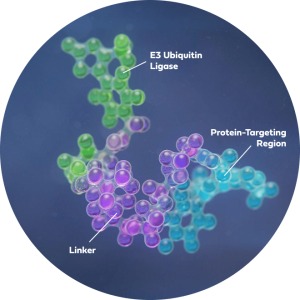
Arvinas is pioneering the discovery and development of novel PROTAC (PROteolysis-TArgeted Chimera) protein degraders as potential disease modifying therapies for neurologic disease with high unmet need. Many CNS targets have been considered “undruggable,” and are further complicated by the difficulty of delivering therapeutic agents (such as genomic modalities and antibodies) into the brain. Arvinas is exploring new and exciting territory, developing blood-brain barrier penetrant PROTACs against target proteins that are genetically implicated in neurodegenerative diseases, such as progressive supranuclear palsy (PSP), Parkinson’s disease (PD), Huntington’s disease, Alzheimer’s disease, and neuromuscular disorders like spinal-bulbar muscular atrophy (SBMA).

Elements of Potential PROTAC Differentiation in Neurology:
- Designed to cross the blood-brain barrier to reach deep-brain regions, which is a substantial challenge for monoclonal antibodies and genomic therapies.
- Potential to enter cells of the CNS, degrading pathogenic proteins (such as mutant or oligomeric tau) from the inside of the cell, thus hindering both intracellular dysfunction and “prion-like” spread of pathologic protein into the extracellular space and healthy neurons.
- Designed to selectively degrade mutant forms of pathologic proteins and spare healthy forms such as for mutant huntingtin protein (mHTT).
- Degrading proteins can disrupt the scaffolding function of disease-causing target proteins, such as LRRK2.
- Iterative (often described as “catalytic”) activity, by which a single PROTAC molecule can induce the degradation of hundreds of copies of the disease-causing protein.
- Directed degradation to appropriate tissues while avoiding others, by utilizing cell- or tissue-restricted E3 ligases.
- Oral dosing provides an additional route of administration.
Neurology Pipeline Programs
Mechanism of Action:
ARV-102 is an investigational, orally bioavailable PROTAC designed to specifically target and degrade leucine-rich repeat kinase 2 (LRRK2) in neurodegenerative diseases, which has demonstrated the ability to cross the blood-brain barrier in early clinical trials. LRRK2 is a large, multi-domain scaffolding protein that impacts protein homeostasis and contributes to neuroinflammation in pathological disease states. Preclinical data demonstrate that ARV-102 broadly biodistributes across deep brain regions to degrade LRRK2, with the potential to address patient needs.
Diseases of Interest for Development:
Parkinson’s disease (PD) and PSP are neurodegenerative diseases characterized by abnormal protein misfolding and have overlapping clinical phenotypes associated with movement disorders. Mutations in LRRK2 are known to cause PD, and elevated LRRK2 protein levels and kinase activity plays a role in PD more broadly. Similarly, LRRK2 is genetically linked to PSP, where higher levels of LRRK2 are associated with faster PSP disease progression. In both PD and PSP, elevated LRRK2 contributes to neuroinflammation and impairs protein homeostasis, directly contributing to the accumulation of aggregated alpha-synuclein and tau in PD and PSP, respectively. LRRK2 may also phosphorylate tau through direct and indirect mechanisms. Currently, there is no cure for either disease and treatment options are limited.
Clinical Status:
ARV-102 is currently under investigation in Phase 1 clinical studies in both healthy participants and in patients with Parkinson’s disease. Ongoing studies include:
- ARV-102-101: EUCT 2023-507910-28-00
- ARV-102-103: EUCT 2024-516888-84-00
- ARV-102-104: EUCT 2024-519835-41-00
- ARV-102-105: EUCT 2025-523370-16-00
Mechanism of Action:
ARV-027 is an oral, peripherally restricted investigational PROTAC degrader designed to selectively target and eliminate the polyglutamine-expanded androgen receptor (polyQ-AR) in skeletal muscle to potentially treat SBMA. PolyQ-AR is the root cause of motor dysfunction in SBMA due to the toxic gain of function imparted by the polyQ expansion on the androgen receptor (AR). PolyQ-AR misfolds and aggregates in a ligand-dependent manner, disrupts normal transcription, and impairs muscle and mitochondrial function, ultimately driving progressive neuromuscular degeneration. ARV-027 is a clinical candidate specifically selected for potent in vitro reduction of cytosolic and nuclear polyQ-AR and for favorable skeletal-muscle exposure following oral administration. Preclinical data demonstrated that ARV-027 showed robust pharmacokinetic (PK)/pharmacodynamic (PD)–driven degradation of muscle polyQ-AR in a rapidly progressing polyQ-AR overexpression model.
Diseases of Interest for Development:
SBMA is a rare, X-linked, genetically defined neuromuscular disease caused by a CAG repeat expansion (polyQ) in the AR gene. There are no currently approved disease-modifying therapies for SBMA.
Clinical Status:
Arvinas expects to begin a Phase 1 trial of ARV-027 in 2026.
Addressing “Undruggable” Targets
Arvinas believes its PROTAC degraders represent a promising new approach to treating diseases linked to pathogenic tau, alpha-synuclein, and other important targets. Arvinas is progressing PROTAC degrader programs to directly target three named protein targets (mutant huntingtin (mHTT), tau, and alpha-synuclein), and a number of undisclosed targets.
Huntington’s disease is caused by a mutation in the HTT gene. PROTAC protein degradation has the potential to enable selective targeting of mHTT protein. In preclinical studies, Arvinas has identified ligands that, when incorporated into a PROTAC protein degrader molecule, induce potent degradation of mHTT. Protein degradation requires binding to both the target and E3 ligase. Our PROTAC molecule induces potent degradation of mHTT while sparing the protein produced by the wild-type HTT gene.
The tau protein is normally found in axons of healthy neurons of the central nervous system, and when it is mutated or under pathologic conditions, it has been implicated in a group of diseases known as tauopathies. Of these disorders, Alzheimer’s is an example. In this group of diseases, the pathologic tau protein dissociates from axons, negatively impacts neuronal function, becomes phosphorylated, acquires additional pathologic post-translational modifications, and forms insoluble clusters of aggregated proteins in the brain known as tangles. In preclinical studies, Arvinas has demonstrated that tau-targeting PROTACs, when dosed peripherally, degrade several different forms of tau, including phosphorylated forms, resulting in reduced insoluble aggregated tau in a mouse tauopathy model.
Alpha-synuclein (α-syn) is an abundant neuronal protein that localizes predominantly to presynaptic terminals within the brain. While the precise normal function of this protein is not fully understood, the pathologic aggregation of α-syn is implicated in synucleinopathies. The most common of these diseases is Parkinson’s.
Arvinas is working on approaches to degrade α-syn and remove this protein from neurons that lead to pathology in diseases such as Parkinson’s Disease, multiple system atrophy, and Lewy body dementia.
The agents listed above are currently under investigation. Their safety and effectiveness have not been established.
View our latest neurology-focused scientific presentations:
- Cacace, A. (2019, October 24). Discovery of Brain Penetrant PROTAC Degrader Molecules That Target Pathologic Tau and alpha-Synuclein Protein Species [1-22]. Presented at: Targeted Protein Degradation Summit. Boston, MA. https://s3.us-east-1.amazonaws.com/arvinas-assets.investeddigital.com/scientific-publications/Cacace_TPD-10-24-2019_final.pdf
- Pardridge, W. M. (2020). Blood-brain barrier and delivery of protein and gene therapeutics to brain. Frontiers in Aging Neuroscience, 11. https://doi.org/10.3389/fnagi.2019.00373
- Mazur, C., Powers, B., Zasadny, K., Sullivan, J. M., Dimant, H., Kamme, F., Hesterman, J., Matson, J., Oestergaard, M., Seaman, M., Holt, R. W., Qutaish, M., Polyak, I., Coelho, R., Gottumukkala, V., Gaut, C. M., Berridge, M., Albargothy, N. J., Kelly, L., Carare, R. O., … Verma, A. (2019). Brain pharmacology of intrathecal antisense oligonucleotides revealed through multimodal imaging. JCI insight, 4(20), e129240. https://doi.org/10.1172/jci.insight.129240
- Kouhi, A., Pachipulusu, V., Kapenstein, T., Hu, P., Epstein, A. L., & Khawli, L. A. (2021). Brain Disposition of Antibody-Based Therapeutics: Dogma, Approaches and Perspectives. International journal of molecular sciences, 22(12), 6442. https://doi.org/10.3390/ijms22126442
- Silva M. C., Ferguson F. M., Cai Q., Donovan K. A., Nandi G., Patnaik D., et al. (2019). Targeted degradation of aberrant tau in frontotemporal dementia patient-derived neuronal cell models. Elife 8, e45457. 10.7554/eLife.45457. https://pubmed.ncbi.nlm.nih.gov/30907729/
- Silva, M. C., Nandi, G., Donovan, K. A., Cai, Q., Berry, B. C., Nowak, R. P., Fischer, E. S., Gray, N. S., Ferguson, F. M., & Haggarty, S. J. (2022). Discovery and optimization of tau targeted protein Degraders enabled by patient induced pluripotent stem cells-derived neuronal models of Tauopathy. Frontiers in Cellular Neuroscience, 16. https://doi.org/10.3389/fncel.2022.801179
- Bond M.J. and Crews, C.M. (2021). PROTACs come of age: entering the third decade of targeted protein degradation. RSC Chem. Biol. https://pubs.rsc.org/en/content/articlepdf/2021/cb/d1cb00011j
- Bekes M., Langley, D. R., and Crews, C.M. (2022). PROTAC targeted Protein Degraders: the past is prologue. Nat. Rev. Drug Disc. https://www.nature.com/articles/s41573-021-00371-6
- Cacace, A. (2021, July 14). PROTAC Discovery Engine: Harnessing power of oral blood brain barrier penetrant degraders and new E3 ligases (1-22). Presented at Protein Society Meeting. Virtual. https://s3.us-east-1.amazonaws.com/arvinas-assets.investeddigital.com/scientific-publications/Angela-Cacace-Protein-Society-July-2021_2021-08-06-014908_ebim.pdf
- Cacace, A.M., Meredith, J., Bryce, D., Sparks, S., Kimmel., L., Kelly, K., Gregory, J., Matchett, M., Nickischer, D., Hendricson, A., Naumann, G., Kyne, R., Wilson., J., Corradi, J., Soto, L., Jeong, Y., Pizzano, J., Cadelina, G., Revell, D., Snyder, L., Berlin, M. (2022, November 12-16). Presented at Society for Neuroscience. San Diego, CA. Clearance of Pathologic Proteins in Neurodegeneration by oral PROTAC® Degrader Molecules.
- Burslem, G. M., Smith, B. E., Lai, A. C., Jaime-Figueroa, S., McQuaid, D. C., Bondeson, D. P., Toure, M., Dong, H., Qian, Y., Wang, J., Crew, A. P., Hines, J., & Crews, C. M. (2018). The Advantages of Targeted Protein Degradation Over Inhibition: An RTK Case Study. Cell chemical biology, 25(1), 67–77.e3. https://doi.org/10.1016/j.chembiol.2017.09.009 https://www.ncbi.nlm.nih.gov/pmc/articles/PMC5831399/#__ffn_sectitle
- Wang, X., Negrou, E., Maloney, M. T., Bondar, V. V., Andrews, S. V., Montalban, M., Llapashtica, C., Maciuca, R., Nguyen, H., Solanoy, H., Arguello, A., Przybyla, L., Moerke, N. J., Huntwork-Rodriguez, S., & Henry, A. G. (2021). Understanding LRRK2 kinase activity in preclinical models and human subjects through quantitative analysis of LRRK2 and pT73 Rab10. Scientific reports, 11(1), 12900. https://doi.org/10.1038/s41598-021-91943-4
- Zhao, Y., & Dzamko, N. (2019). Recent Developments in LRRK2-Targeted Therapy for Parkinson’s Disease. Drugs, 79(10), 1037–1051. https://doi.org/10.1007/s40265-019-01139-4
- Henderson, M. X., Sengupta, M., McGeary, I., Zhang, B., Olufemi, M. F., Brown, H., Trojanowski, J. Q., & Lee, V. M. Y. (2019). LRRK2 inhibition does not impart protection from α-synuclein pathology and neuron death in non-transgenic mice. Acta neuropathologica communications, 7(1), 28. https://doi.org/10.1186/s40478-019-0679-5
- Berwick, D.C., Heaton, G.R., Azeggagh, S. et al. (2019). LRRK2 Biology from structure to dysfunction: research progresses, but the themes remain the same. Mol Neurodegeneration 14, 49 https://doi.org/10.1186/s13024-019-0344-2
- Cacace, A. (2019, October 24). Discovery of Brain Penetrant PROTAC Degrader Molecules That Target Pathologic Tau and alpha-Synuclein Protein Species [1-22]. Presented at: Targeted Protein Degradation Summit. Boston, MA. https://s3.us-east-1.amazonaws.com/arvinas-assets.investeddigital.com/scientific-publications/Cacace_TPD-10-24-2019_final.pdf
- Change, C.-W., Shao, S., Mucke, L. (2021). Tau: enabler of diverse brain disorders and target of rapidly evolving therapeutic strategies. Science. 371(6532). https://www.ncbi.nlm.nih.gov/pmc/articles/PMC8118650/pdf/nihms-1682624.pdf
- Rideout, H., Greggio, E., Kortholt, A., Nichols, R. J. (2022). Editorial: LRRK2—Fifteen Years From Cloning to the Clinic. Frontiers in Neuroscience. https://www.frontiersin.org/articles/10.3389/fnins.2022.880914
- Rocha, E.M., Keeney, M.T., Di Maio, R., De Miranda, B.R., Greenamyre, J.T. (2022). LRRK2 and idiopathic Parkinson’s disease. Trends in Neuroscience. 45(3), P224-236. https://www.cell.com/action/showPdf?pii=S0166-2236%2821%2900250-2
- Langston, R.G., Beilina, A., Reed, X., Kaganovich, A., Singleton, A.B., Blauwendraat, C., Gibbs, J.R., Cookson, M.R. (2022). Association of a common genetic variant with Parkinson’s disease is mediated by microglia. Science Translational Medicine. 14 (655). https://www.science.org/doi/10.1126/scitranslmed.abp8869
- Tabrizi SJ, Estevez-Fraga C, van Roon-Mom WMC, Flower MD, Scahill RI, Wild EJ, Muñoz-Sanjuan I, Sampaio C, Rosser AE, Leavitt BR. (2022) Potential disease-modifying therapies for Huntington’s disease: lessons learned and future opportunities. Lancet Neurol. (7):645-658. https://www.ncbi.nlm.nih.gov/pmc/articles/PMC7613206/pdf/EMS146360.pdf.
- Goedert M, Jakes R, Spillantini MG. The Synucleinopathies: Twenty Years On. (2017) J Parkinsons Dis. 7(s1):S51-S69. https://www.ncbi.nlm.nih.gov/pmc/articles/PMC5345650/pdf/jpd-7-jpd179005.pdf
- Taymans et al. Perspective on the current state of the LRRK2 field. npj Parkinsons Dis. (2023).
- Herbst et al. The emerging role of LRRK2 in tauopathies. Clin Sci (Lond). 2022; 136 (13): 1071–1079.
- Lee et al. Targeting the mutant androgen receptor with PROTACs in spinal and bulbar muscular atrophy. Neurotherapeutics. 22;6: e00771
- Gregory et al. Oral ARV-027 Induces PolyQ-AR Degradation and Improves Muscle Strength and Endurance in a Murine Model of SBMA. Presented at WMS 2025.
- Arvinas Presents First-in-Human Data for Investigational Oral PROTAC ARV-102 Demonstrating Blood-Brain Barrier Penetration, and Central and Peripheral LRRK2 Degradation. (Press Release, April 4, 2025).
- Arvinas Presents Late Breaking, Positive Phase 1 Clinical Data for ARV-102, a PROTAC LRRK2 Degrader, at the 2025 International Congress of Parkinson’s Disease and Movement Disorders®. (Press Release, October 5, 2025).